
Information Technology, or known as IT, has gained more importance in recent years as our world continues to digitise, due to its imperative role in maintaining communications and data processing for different industries. IT experts are the lifeline of a business – if a business’ database is not properly maintained, it may just be enough for a business to collapse. To play such an important role means you will need the necessary education background. Here is everything you need to know about studying Information Technology in Malaysia.
An Introduction into Information Technology
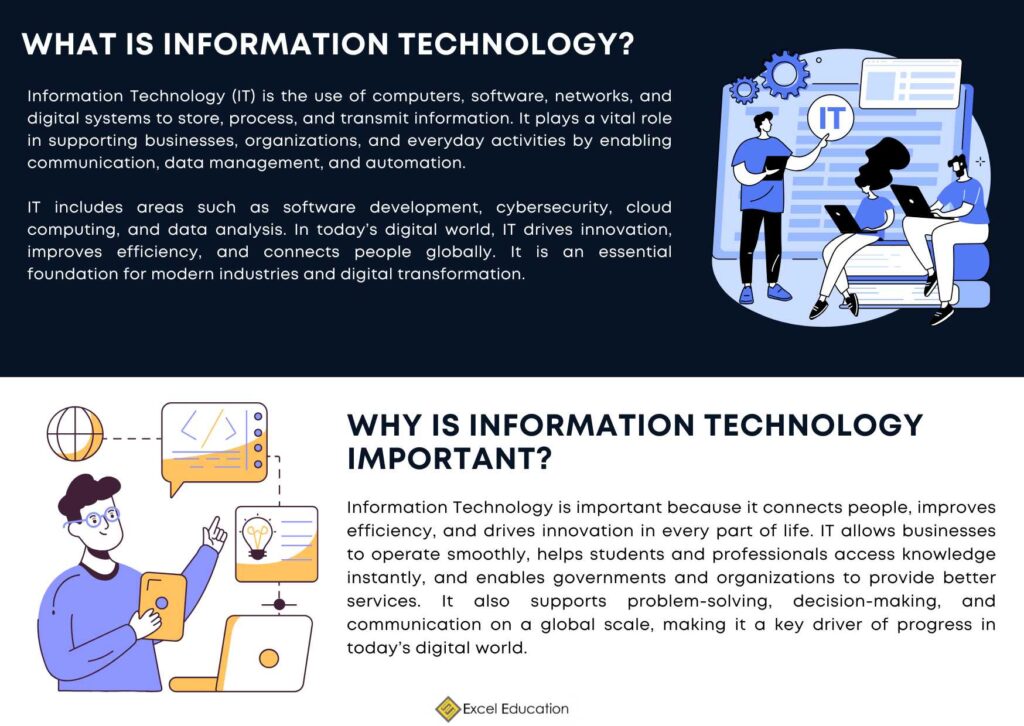
We hear the term ‘IT’ being tossed around all the time in schools or offices as a department, but what is it exactly? In essence, IT (also known as Information Technology) is the study and use of computers, networks, storage, and infrastructure to create, store, maintain, process, secure, and exchange data. It is typically used on a larger scale, mainly in the context of business operations, rather than for entertainment and at home use. It is a hybrid between computing technologies and telecommunications. IT is the backbone of today’s digital world, driving innovation across industries such as finance, healthcare, education, manufacturing, and e-commerce.
In recent years, the IT industry has gained more importance as our world continues to digitise, due to its imperative role in maintaining communications and data processing for different industries. IT experts are the lifeline of a business – if a business’s database is not properly maintained, it may just be enough for a business to collapse. To play such an important role means you will need the necessary education background.
In Malaysia, the relevance of Information Technology continues to grow as the country advances toward a digital economy. Government initiatives such as MyDIGITAL, the expansion of Industry 4.0, and increased investment in data centres, fintech, and technology startups have significantly increased demand for skilled IT professionals. Malaysian businesses now require graduates who are not only technically competent but also adaptable to real-world challenges, cybersecurity risks, and rapidly evolving digital platforms.
Students in IT usually learn concepts like technical theory, networking, programming, computer hardware, database management, system analysis, computer circuitry, website development, and IT management. Though of course this depends on what individual courses have to offer, to learn more about the different IT course structures from different universities, ask Excel Education.
As a strong arm of a company or organisation’s IT database, you will be responsible for things like launching and maintaining business applications, services, servers, networks, and storage. You are also expected to monitor, optimise, troubleshoot, and monitor the security of said IT assets of a business to ensure their functions and safety are in order. At times, you should also make sure the technology (e.g. hardware and programs) are up to date and change them if it’s required to ensure proper IT support is provided to a business for smooth operations.
What Are the Different Specialisations in Information Technology?
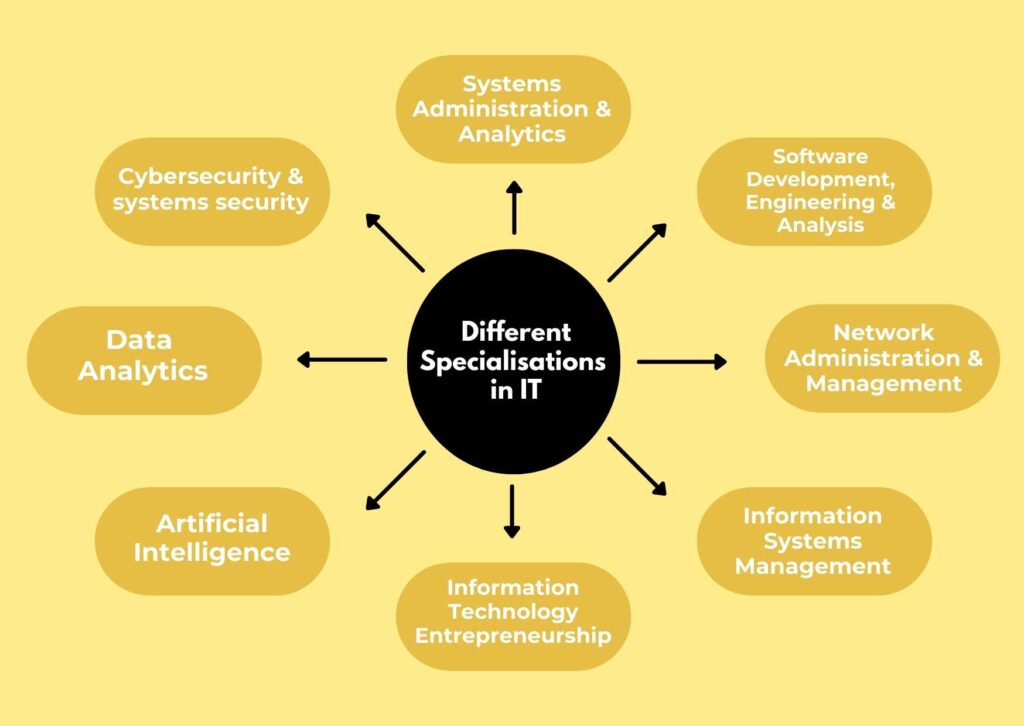
Information Technology degrees have a wide range of specialisations and is not limited to dealing with IT databases. Many Information Technology degrees include modules that overlap with Computer Science knowledge, it is important to have a wide range of relevant knowledge! This overview of the specialisations in Information Technology can assist you in deciding a course and selecting modules for your degree:
|
Field |
Description |
|
Cybersecurity & systems security |
The protection of applications, networks, and data from harm. You’ll typically learn concepts such as: information security, ethical hacking, information assurance, disaster recovery, vulnerability analysis and control, coding security, and securing databases. |
|
Data Analytics |
The construction, development, and management of data to maintain network infrastructure to meet client needs. You’ll utilise predictive modelling, big data, and sample data sets to solve specific problems. |
|
Artificial Intelligence |
The Artificial Intelligence specialisation focuses on designing intelligent systems that can learn, analyse data, and make decisions, preparing students for future-ready careers in technology, innovation, and problem-solving |
|
Information Technology Entrepreneurship |
The business knowledge of launching and maintaining new ventures in the tech industry. |
|
Information Systems Management |
The study of construction, testing and maintenance of information to ensure their effectiveness in a business. |
|
Network Administration & Management |
The study of construction, testing and maintenance of network applications to ensure their effectiveness in a business. |
|
Software Development, Engineering & Analysis |
Overlapping with Computer Science, you will utilise coding and programming languages to build applications and programs to deal with specific needs. |
|
Systems Administration & Analytics |
The specialisation of administration and management of servers. |
For more information about different types of information technology and which one is the most suitable one for you, contact us now for more details!
Why Study Information Technology?
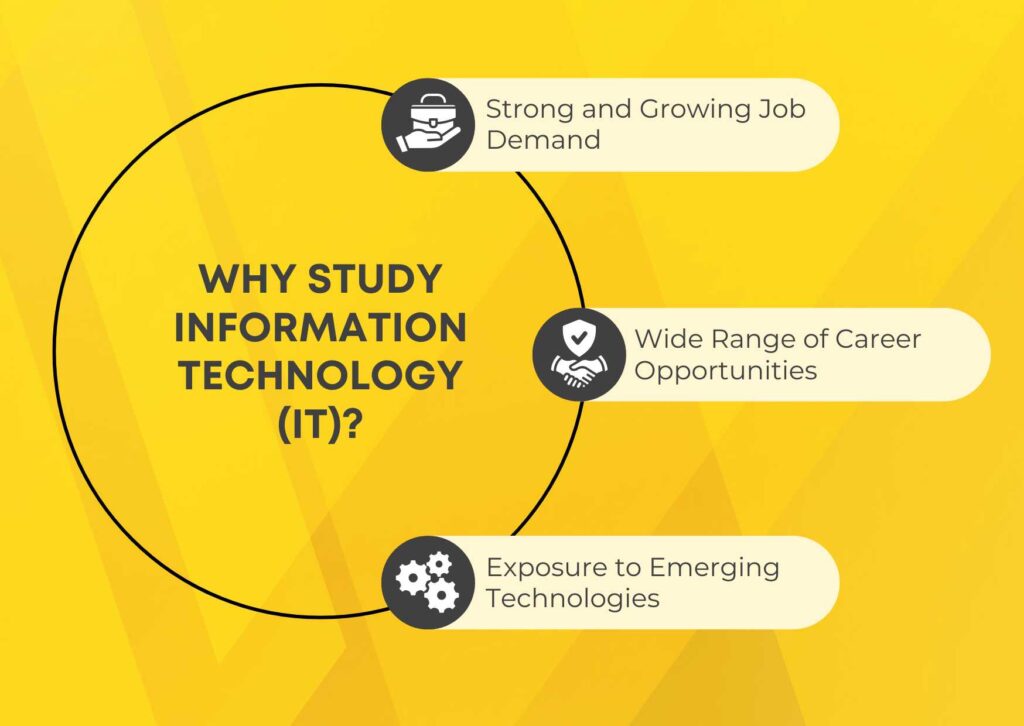
Strong and Growing Job Demand
Digital transformation continues across all industries, including finance, healthcare, education, logistics, manufacturing, and government services. In 2026, organisations increasingly rely on IT professionals to manage systems, data, and digital infrastructure, making IT graduates consistently in demand.
Wide Range of Career Opportunities
An IT degree opens doors to diverse roles such as software developer, data analyst, cybersecurity specialist, cloud engineer, IT consultant, and systems administrator. This flexibility allows graduates to move between industries and specialisations as technology evolves, providing long-term career resilience.
Exposure to Emerging Technologies
In 2026, IT programmes cover cutting-edge areas such as artificial intelligence (AI), machine learning, cloud computing, big data, Internet of Things (IoT), and cybersecurity. This exposure helps graduates stay relevant in a fast-changing technology landscape
Career Opportunities in Information Technology
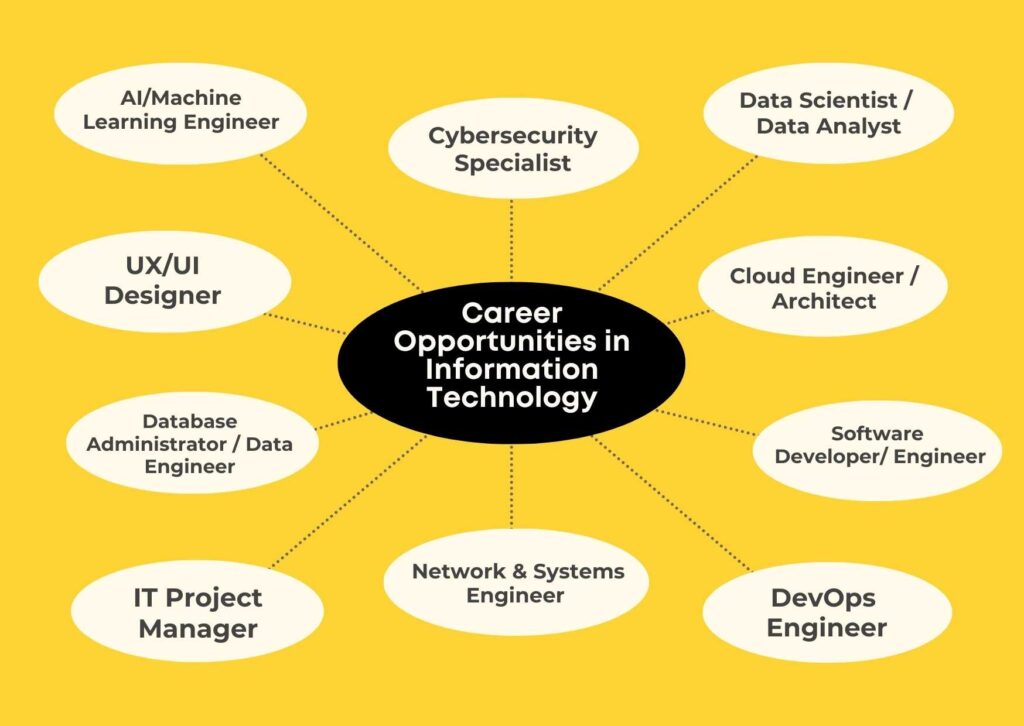
IT is the lifeline of a healthy business, your skills will be needed anywhere. Your future career path as an IT degree holder is bright, so here are a few examples of what you can do:
Roles | Key Task |
Artificial Intelligence/Machine Learning Engineer | Designs, builds, and deploys AI systems using techniques like machine learning and deep learning. This is one of the fastest-growing tech roles as companies invest heavily in automation and intelligence. |
Cybersecurity Specialist | Protects systems, networks, and data from threats by developing security strategies, monitoring breaches, and responding to attacks. Cybersecurity professionals are essential due to rising digital threats. |
Data Scientist / Data Analyst | Analyzes large datasets to uncover insights, support business decisions, and build predictive models. Demand for data professionals continues to grow across industries. |
Cloud Engineer / Cloud Architect | Designs and manages cloud infrastructure and services, enabling scalable, secure computing environments. This is vital as organizations migrate to cloud platforms. |
Software Developer / Software Engineer | Develops applications, systems, and software solutions for web, mobile, or enterprise platforms. This remains a core IT profession with strong demand globally. |
DevOps Engineer | Bridges software development and operations to improve deployment efficiency and reliability using automation tools. This is an increasingly important role in modern IT teams. |
Network & Systems Engineer / Administrator | Ensures the smooth operation of an organization’s IT infrastructure, including networks, servers, and systems, providing support and performance optimization. |
IT Project Manager | Leads and coordinates IT projects, aligning technology initiatives with business goals and managing teams, timelines, and budgets. |
Database Administrator / Data Engineer | Designs, manages, and optimizes databases and data pipelines that store and deliver critical business information. |
UX/UI Designer & Mobile Application Developer | Focuses on user experience and interface design, especially for mobile and web applications, blending technical and creative skills. Demand continues as digital products proliferate. |
General Entry Requirements to Study Information Technology in 2026
Academic Entry Requirements
STPM | Min. Grade C in 2 subjects |
Foundation/Matriculation | Pass with min. CGPA of 2.0 with a Credit in Additional Mathematics at SPM/ IGCSE/ O-Level or its equivalent |
A-Levels | Pass with min. EE |
Unified Examination Certificate (UEC) | Pass with min. 5 Bs including Mathematics or Advanced Mathematics |
Canadian Pre-University (CPU) | Min. average of 50% in 6 subjects |
International Baccalaureate (IB) | Min. of 24 points in 6 subjects |
Diploma in Information Technology (DIT) | Pass with min. CGPA of 2.50 |
South Australian Matriculation (SAM) / SACE International | Min. ATAR 55 |
*Requirements vary across universities, faculties, and courses. For inquiries on the specific requirements, contact Excel Education.
English Language Requirements
IELTS | Band 5.0 |
TOEFL | 42 (Internet Based Test) |
MUET | Band 3 |
O-Level | Grade C |
1119 | Grade C |
UEC English | B6 |
*Requirements vary across universities, faculties, and courses. For inquiries on the specific requirements, contact Excel Education.
Top Universities to Study Information Technology in Malaysia
Taylor’s University

Taylor’s University is a highly recognised private university in Malaysia that ranks #253 in the QS World University Rankings 2026, placing it among the top 1% of universities worldwide and the #1 non‑government linked private university in Southeast Asia.
It also ranks #27 in the QS Asia University Rankings 2026, reflecting strong regional academic performance and global reputation. Taylor’s is known for its high graduate employability (around 99.5%), strong industry links, and a diverse international student community, with notable subject strengths in areas like hospitality, data science, and business.
The Bachelor of Information Technology (Honours) at Taylor’s University equips students with strong technical skills in software development, networks, cybersecurity, and database systems to support and manage modern IT environments.
The programme emphasises analytical thinking and real-world problem solving, teaching students how to align IT solutions with organisational and business goals. It covers both software development and hardware infrastructure, preparing graduates to manage and support organisational IT systems in diverse careers such as system administrator, IT analyst, software developer, and information security analyst.
|
Program Name |
Bachelor of Information Technology (Honours) |
|
Intake |
February, April, September |
|
Duration |
3 Years |
|
Indicative Fees (2026) |
Local students: RM40,577 per annum International students: RM48,435 per annum |
For more information on course structure, entry requirement, duration, fees and scholarship availability offered, contact us!
Sunway University

Sunway University is one of Malaysia’s leading private universities in 2026, known for its strong global reputation, high graduate employability, and industry relevant education. Ranked within the top 500 universities worldwide, Sunway is recognised for its academic quality, international partnerships, and emphasis on practical learning.
The university offers well-regarded programmes in areas such as Information Technology, computer science, business, and engineering, with a strong focus on internships, real-world projects, and career readiness, making it a popular choice for students seeking globally competitive education in Malaysia.
The university equips students with strong technical and practical skills in areas such as software development, IT infrastructure, networking, and cybersecurity, supported by hands-on learning and industrial training. Designed to meet industry demands, the courses prepare graduates for a wide range of IT careers across various sectors. Students also graduate with a dual-award degree from Sunway University and Lancaster University (the largest provider of UK transnational education in Malaysia), enhancing their global recognition and employability.
Program Name | Bachelor of Science (Honours) in Information Technology |
Intake | January, April, September |
Duration | 3 Years |
Indicative Fees (2026) | Local students: RM37,850 per annum International students: RM36,143 per annum |
For more information on course structure, entry requirement, duration, fees and scholarship availability offered, contact us!
Asia Pacific University (APU)

The Asia Pacific University of Technology and Innovation, or commonly known APU, is an award-winning higher institution in Malaysia which advocates for integrating technology, innovation, and creativity into their curriculum with hopes of contributing to shaping skilled, versatile, and employable graduates.
Asia Pacific University provides students with a solid foundation in a wide range of information technologies and their practical uses. It covers strategic planning and management frameworks for organizational information systems. Students also learn to critically assess and apply suitable strategies and techniques in developing IT solutions.
Program Name | Bachelors of Science (Honours) in Information Technology |
Intake | March, July, September |
Duration | 3 Years |
Indicative Fees (2026) | Local students: RM34,867 per annum International students: RM36,166 per annum |
For more information on course structure, entry requirement, duration, fees and scholarship availability offered, contact us!
UCSI University

UCSI University is a leading private university in Malaysia that has consistently ranked in the top 1% of universities worldwide, placing #269 in the QS World University Rankings 2026 for the fourth consecutive year. It is also ranked #30 in Asia and has strong sustainability recognition, including high regional positions in the QS Sustainability rankings. The university offers a wide range of programmes and maintains a diverse, international student community, emphasising academic excellence, employability, and industry engagement.
The Computer Science degree at UCSI University provides students with a solid foundation in software and systems development, along with the skills to implement and integrate emerging technologies. Graduates are prepared to enhance efficiency and innovation across various industries, from business to entertainment and social enterprises.
Program Name | Bachelor Of Computer Science (Honours) |
Intake | January, May, September |
Duration | 3 Years |
Indicative Fees (2026) | Local students: RM26,993 per annum International students: RM32,827 per annum |
For more information on course structure, entry requirement, duration, fees and scholarship availability offered, contact us!
INTI University

Asia INTI International University & Colleges in Malaysia is a well-established private university based primarily in Nilai, Negeri Sembilan, offering a wide range of industry-relevant programmes in fields like business, engineering, IT, health sciences, and design. In 2026, INTI is ranked #509 in the QS World University Rankings and #122 in the QS Asia rankings, reflecting steady regional and global progress and recognition for quality education and internationalisation.
INTI’s technology programmes prepare students for the rapidly evolving digital world by equipping them with future-ready skills, industry expertise, and hands-on experience. Through collaborations with leading global IT providers and innovators, students gain access to cutting-edge technologies, professional certifications, and insights from international academics and industry experts.
The curriculum is continuously updated to reflect key areas such as AI, cloud computing, cybersecurity, fintech, and data analytics, while compulsory internships, real-world projects, and industry workshops ensure graduates are workplace-ready, adaptable, and highly employable.
Program Name | Bachelor of Information Technology (Honours) |
Intake | January, May, August |
Duration | 3 Years |
Indicative Fees (2026) | Local students: RM25,956 per annum International students: RM25,956 per annum |
For more information on course structure, entry requirement, duration, fees and scholarship availability offered, contact us!
Recommended Articles to Read
Contact us to find out more!
Email: i[email protected]

About The Author

Yit Hong
A content writer & a student of University of Nottingham studying Bachelor of Communications. I like indie bands and meeting new people 🙂