

What is Information Technology?
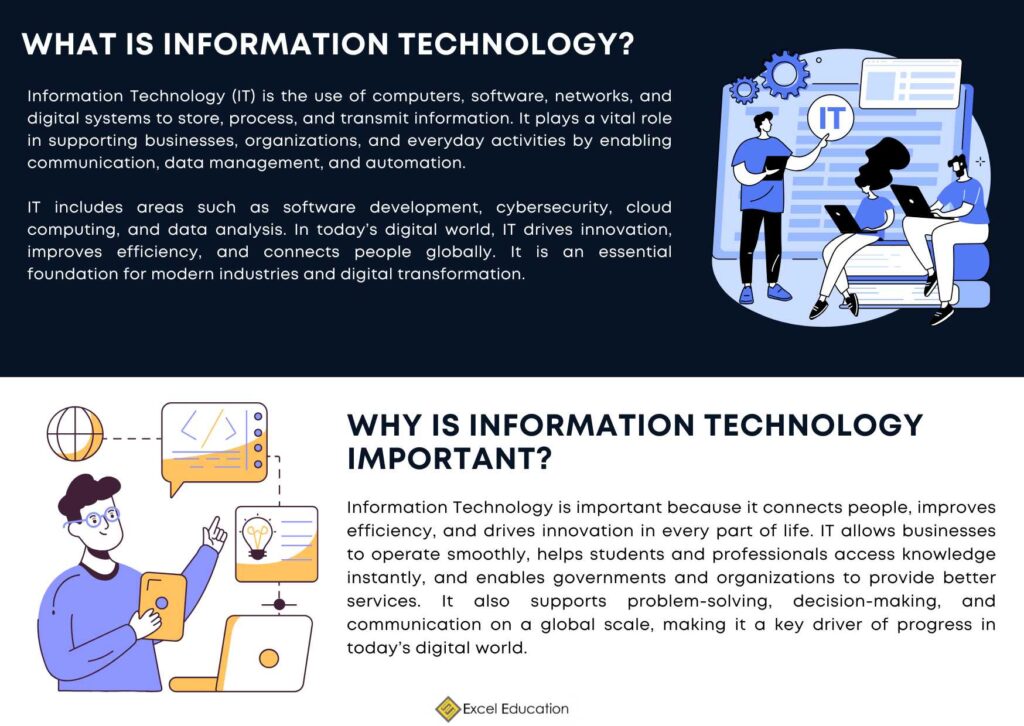
Information Technology (IT) is the backbone of the modern digital economy. It encompasses the design, development, deployment and management of computer systems, software, networks and data enabling businesses, governments and everyday users to create, process, store and communicate information efficiently. From software development and cybersecurity to cloud computing, data analytics and artificial intelligence, IT is essential in virtually every sector today, shaping innovation, productivity and economic growth.
The UK’s IT and tech industry remains one of Europe’s most dynamic and influential sectors. The broader tech ecosystem (which includes core IT activities) has grown into a multi-trillion dollar market, leading Europe in both scale and innovation. The UK tech workforce has been expanding steadily, with over 2.2 million people employed in tech-related roles and projected job growth continuing to this day. Technical skills in areas such as cloud infrastructure, software engineering, data and cybersecurity are among those most sought after by employers.
Cutting-edge technologies like artificial intelligence (AI), cloud computing and data-driven systems are driving much of this growth, with businesses investing heavily to digitalise operations and compete on a global scale. London, Manchester, Edinburgh and other UK cities have become vibrant hubs for tech innovation, supported by a mix of startups, established firms and strong university research partnerships.
Why Study Information Technology in the UK?
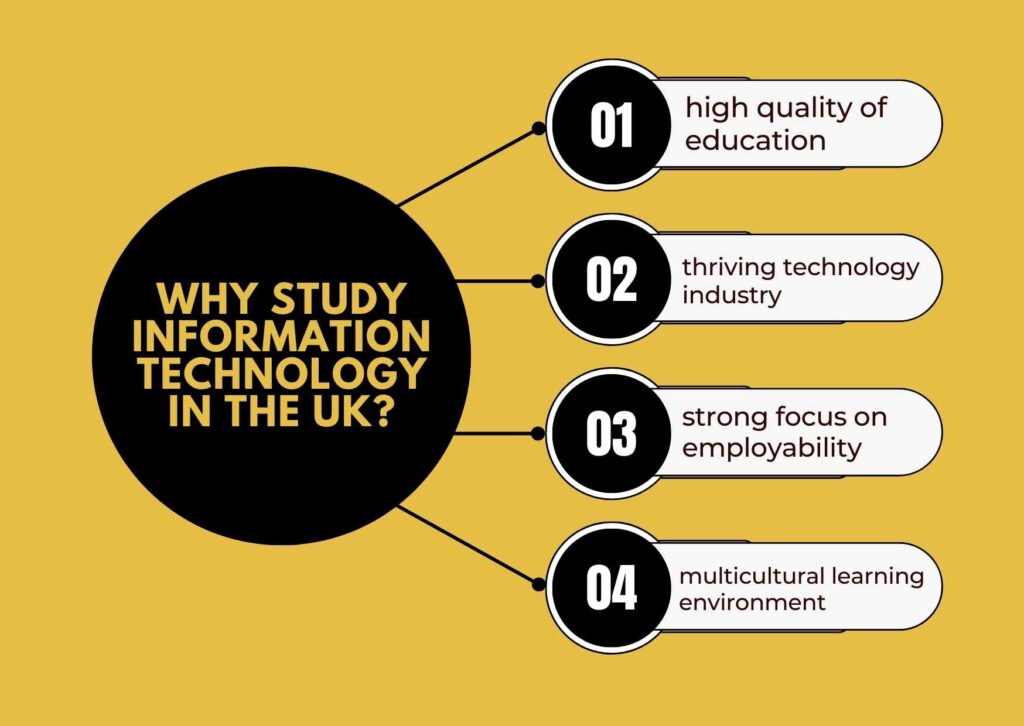
The UK is one of the most attractive destinations in the world for students pursuing a degree in IT. With its globally recognised universities, strong technology industry and career-focused education system, the UK offers an ideal environment for developing both technical expertise and professional skills.
One of the key reasons to study IT in the UK is the high quality of education. UK universities are consistently ranked among the best in the world for computing and technology-related subjects. IT programmes are designed to balance theory with practical application, ensuring students gain hands-on experience in areas such as software development, cybersecurity, data science, cloud computing and artificial intelligence.
The UK also has a thriving technology industry, making it an excellent place to build a career after graduation. Major cities like London, Manchester, Edinburgh and Birmingham are home to global tech companies, innovative startups and research centres. This strong industry presence creates valuable opportunities for internships, placements, live projects and networking during study.
Another advantage is the UK’s strong focus on employability. Many IT courses are developed in collaboration with industry partners, and universities place emphasis on real-world problem solving, teamwork and professional development. Graduates from UK universities are highly regarded by employers worldwide.
For international students, the UK offers a multicultural learning environment and exposure to global perspectives in technology. In addition, post-study work opportunities allow graduates to gain professional experience in the UK after completing their degree, making it easier to transition from education to employment.
Visa Options and Post-Study Work Opportunities
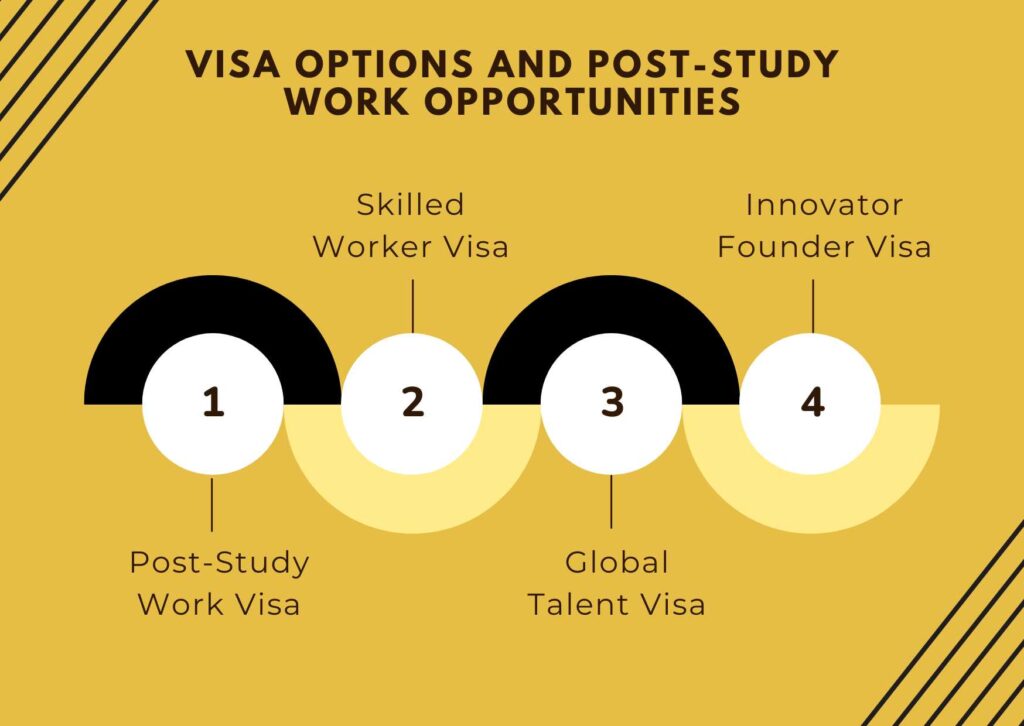
The UK offers several post-study visa options that allow international Artificial Intelligence graduates to gain work experience and build long-term careers.
Graduate Route (Post-Study Work Visa)
The Graduate Route allows international students to stay in the UK after completing their degree to work, look for work, or be self-employed.
- Available for up to 2 years for undergraduate and master’s graduates
- No job offer or sponsorship required
- Acts as a short-term pathway to gain industry experience and transition to other visas
Skilled Worker Visa
Graduates who secure a job with a UK-licensed sponsor can switch to the Skilled Worker visa.
- Suitable for long-term employment in AI and technology roles
- Requires meeting skill and salary thresholds
- Can lead to permanent residency (Indefinite Leave to Remain)
Other Pathways
Global Talent Visa: For highly skilled or research-focused AI professionals
Innovator Founder Visa: For graduates planning to launch AI or tech startups
Why this Matters?
These visa options make the UK attractive for AI students by offering flexible post-study work opportunities and clear routes to long-term career growth.
Career Opportunities in AI
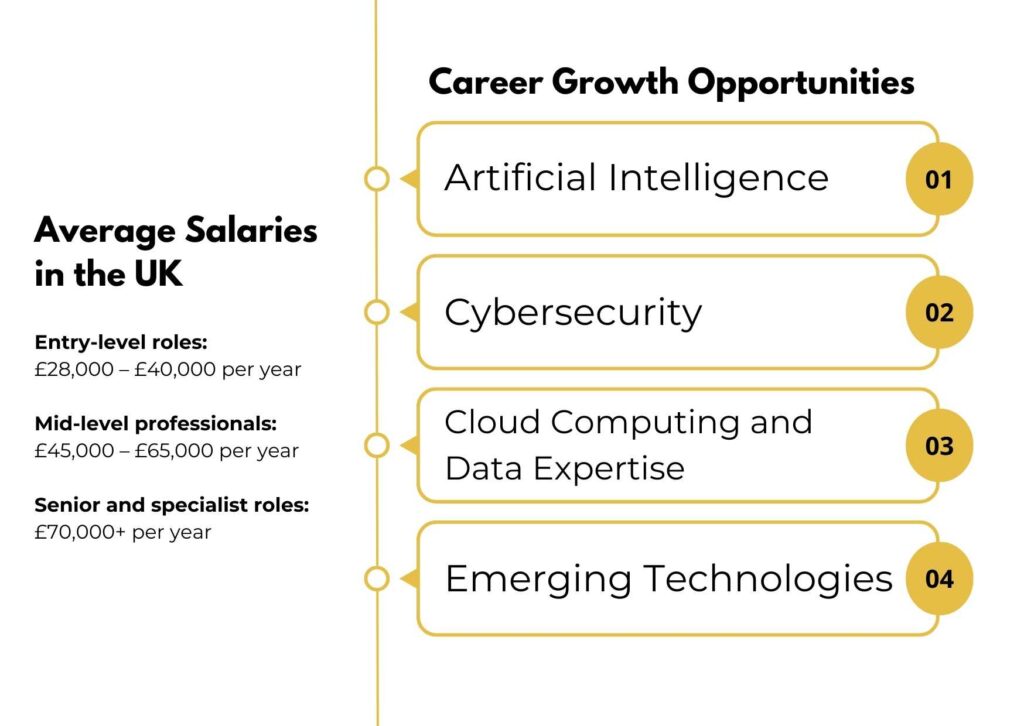
The UK IT industry offers strong earning potential and long-term career growth, particularly for graduates specialising in Artificial Intelligence, data science, and software development.
Average Salaries in the UK
Entry-level roles (Graduate Software Engineer, Junior Data Scientist):
£28,000 – £40,000 per year
Mid-level professionals (AI Engineer, Machine Learning Engineer):
£45,000 – £65,000 per year
Senior and specialist roles (AI Architect, Lead Data Scientist):
£70,000+ per year, with top roles exceeding £90,000
Salaries are generally higher in London and major tech hubs, and in companies working on advanced AI, fintech, or research-driven projects.
Career Growth Opportunities
The future of Information Technology is being shaped by rapid digital transformation, automation, and the growing integration of technology across all industries. Over the next 5–10 years, IT graduates can expect strong career growth, particularly in roles that combine technical expertise with problem-solving, innovation, and adaptability.
Artificial Intelligence and Automation Will Redefine IT Roles
Artificial Intelligence (AI) is no longer a niche field — it is becoming a core component of modern IT systems. From intelligent software and predictive analytics to automation tools, AI is reshaping how organizations operate. As a result, professionals who can design, manage, and optimize AI-driven systems will be in high demand. Rather than replacing IT jobs entirely, AI is expected to augment roles, allowing professionals to focus on higher-value, strategic work.
Key career paths:
- AI Engineer
- Machine Learning Specialist
- Data Scientist
- AI Solutions Architect
Cybersecurity Will Remain a Critical Priority
With increasing reliance on digital platforms, cloud services, and remote work, cybersecurity threats are growing in both frequency and complexity. Protecting sensitive data, systems, and infrastructure has become mission-critical for organizations worldwide. Cybersecurity is expected to offer long-term stability, as demand continues to outpace the supply of skilled professionals.
Key career paths:
- Cybersecurity Analyst
- Security Engineer
- Ethical Hacker
- Information Security Manager
Cloud Computing and Data Expertise Will Power Future IT Systems
Cloud platforms now form the backbone of modern IT infrastructure, while data drives business decisions across sectors. Skills in cloud architecture, data engineering, and analytics are therefore among the most valuable in the IT job market. Graduates with hands-on experience in cloud platforms and data technologies will have a strong advantage in the job market.
Key career paths:
- Cloud Architect
- DevOps Engineer
- Data Engineer
- Business/Data Analyst
Emerging Technologies Will Create New and Specialised Career Paths
As technology continues to advance, emerging fields are opening up new and highly specialised IT career opportunities. These roles often sit at the intersection of software development, data, and systems engineering, and are particularly attractive to graduates who enjoy innovation and problem-solving.
Key career paths:
- Internet of Things (IoT): IoT Developer, Embedded Systems Engineer
- Blockchain: Blockchain Developer, Smart Contract Engineer
- AR/VR: AR/VR Developer, XR Designer
- Edge Computing: Edge Systems Engineer, Network Architect
- Robotics & Automation: Robotics Engineer, Automation Specialist
With competitive salaries, rapid career progression, and global demand for AI expertise, the UK IT sector remains one of the most attractive fields for graduates seeking both financial growth and professional advancement.
General Entry Criteria for International Students
Academic Requirement
Academic Entry | Minimum Score |
STPM | A-, B+, B+ |
A-Levels | ABB, with Mathematics required |
Matriculation | CGPA 3.2 |
UEC | B3 in five subjects (excluding Chinese and Malay) |
Diploma | CGPA 3.2 (case-by-case basis) |
Australian Matriculation (ATAR) | 92 |
Note: Universities may have different requirements. To learn more, get in touch with us!
English Requirement
Category | Minimum Score |
IELTS Academic | 6.0 overall with 5.5 in each element. |
Cambridge Certification of Advanced English | 169 overall with 162 in each component |
TOEFL (iBT) | (New System) 4.5 overall with 4 in each component (Old System) 80 overall (with 18 in Reading, 17 in Listening, 20 in Speaking, and 17 in Writing) |
Trinity | ISE II Distinction in every component |
PTE Academic | 64 overall, with 59 in each component |
Note: Universities may have different requirements. To learn more, get in touch with us!
Top Recommended Universities and Programs to Study Information Technology in UK
The United Kingdom is one of the most popular destinations for students pursuing Information Technology, thanks to its globally recognised universities, innovative teaching methods, and strong links to the tech industry.
UK universities offer a wide range of IT programmes covering areas such as software engineering, data science, cybersecurity, cloud computing, and artificial intelligence, allowing students to specialise according to their career goals.
In addition to academic excellence, these programmes emphasise practical learning through projects, research opportunities, and industry collaboration, helping graduates develop skills that are highly valued by employers worldwide.
In this article, I’ll share my top recommendations for studying IT in the UK, including the best universities, popular specialisations, and what makes each option unique, so you can make an informed decision about your future in tech.
University of Oxford

The University of Oxford is one of the world’s oldest and most prestigious universities, located in Oxford, England. Renowned for its academic excellence and global influence, Oxford consistently ranks among the top universities worldwide.
The university offers a broad range of undergraduate and postgraduate programmes and is particularly recognised for its strengths in computer science, artificial intelligence, and cutting-edge research. With a strong focus on innovation, critical thinking, and interdisciplinary study, Oxford attracts students and researchers from across the globe and maintains close ties with industry, government, and research institutions.
The University of Oxford’s Computer Science programme provides a strong foundation in the theory and practice of computing, combining mathematical reasoning with practical problem-solving skills. In the first year and part of the second, students build core knowledge in computer systems, networks, and programming, before choosing from a range of specialised topics. The course also includes group design projects, often in collaboration with industry, giving students hands-on experience and preparing them for careers or further study in computing and technology.
QS Rankings by Subject in 2025 | Rankings in Computer Science and Information Systems: #1 in UK, #5 in the World |
Program | Bachelor of Computer Science |
Intake | October |
Indicative Fees 2026 | £62,820 per annum |
Duration | 3 years |
For more information on the table presented above, contact us now!
University of Cambridge

The University of Cambridge is one of the world’s leading universities, located in Cambridge, England, and is renowned for its long-standing tradition of academic excellence and innovation. Founded in 1209, Cambridge consistently ranks among the top universities globally and is especially well known for its strengths in science, engineering, and technology.
The university offers a wide range of undergraduate and postgraduate programmes, with strong research in areas such as computer science, artificial intelligence, and data science. Its close links with industry and a strong research culture make Cambridge an attractive destination for students seeking both academic depth and real-world impact.
Cambridge offers a broad and rigorous Computer Science programme, with 3-year BA and 4-year MEng options, combining strong theoretical foundations with practical skills in programming, hardware, and system design. Students are taught by leading researchers and engage in group projects, often collaborating with industry, while enjoying state-of-the-art facilities and resources. The course equips graduates with versatile skills highly sought after in computing, AI, hardware design, finance, and technology entrepreneurship.
QS Rankings by Subject in 2025 | Rankings in Computer Science and Information Systems: #2 in UK, #9 in the World |
Program | Bachelor of Computer Science |
Intake | October |
Indicative Fees 2026 | £44,214 per annum |
Duration | 3 years |
For more information on the table presented above, contact us now!
University College London (UCL)

University College London (UCL) is a leading global university located in the heart of London, UK, renowned for its research excellence and interdisciplinary approach to education. Founded in 1826, UCL offers a wide range of undergraduate and postgraduate programmes, including in computer science, artificial intelligence, and data science.
The university emphasizes innovation, practical skills, and collaboration with industry and research institutions, providing students with opportunities to engage in cutting-edge projects. With a diverse international community and strong links to London’s thriving tech sector, UCL is an attractive choice for students aiming to build successful careers in technology and research.
QS Rankings by Subject in 2025 | Rankings in Computer Science and Information Systems: #5 in UK, #24 in the World |
Program | Bachelor of Computer Science |
Intake | September |
Indicative Fees 2026 | £46,700 per annum |
Duration | 3 years |
For more information on the table presented above, contact us now!
The University of Edinburgh

The University of Edinburgh is one of the oldest and most prestigious universities in the UK, located in Scotland’s capital city. Founded in 1583, it is globally recognized for its excellence in research and teaching across a wide range of disciplines, including computer science, artificial intelligence, and data science.
The university combines a strong academic foundation with innovative research opportunities and industry collaborations, making it a popular choice for students seeking cutting-edge knowledge and practical skills. Its vibrant campus and international community provide an enriching environment for both study and personal growth.
Edinburgh’s Computer Science programme combines theory and practical skills, teaching students to design, implement, and use computing systems of all scales, from processors to the internet. The degree covers core concepts in mathematics, logic, and engineering, alongside programming and problem-solving, with links to fields like electronics, biology, and linguistics.
Flexible course options allow students to tailor their learning, and graduates are well-prepared for careers in software, technology, research, and innovation worldwide. Both BSc and BEng pathways are offered, with the BEng accredited by the British Computer Society.
QS Rankings by Subject in 2025 | Rankings in Computer Science and Information Systems: #4 in UK, #23 in the World |
Program | Bachelor of Computer Science |
Intake | October |
Indicative Fees 2026 | £38,900 per annum |
Duration | 4 years |
For more information on the table presented above, contact us now!
University of Surrey

The University of Surrey is a public research university located in Guildford, England, UK. It is known for its strong focus on research, innovation, and employability, with close links to industry across a range of disciplines.
The university offers a wide variety of undergraduate and postgraduate programmes and is particularly well regarded for subjects such as engineering, computer science, business, and health sciences. Surrey provides a supportive campus environment and emphasises practical learning through placements and professional training opportunities that help students develop real-world skills.
The University of Surrey’s Computer Science programme has a strong record of graduate employability, with 95% of undergraduates entering employment or further study. The BSc and MEng courses equip students with skills to design and understand modern computational systems, covering areas such as artificial intelligence and cybersecurity, and programming in languages like Java and Python.
Students are taught by leading academics, benefit from guest lectures by industry experts, and can gain real-world experience through Surrey’s award-winning Professional Training placements with major companies including Microsoft, Nintendo, Sony, and IBM.
QS Rankings by Subject in 2025 | Rankings in Computer Science and Information Systems: #16 in UK, #184 in the World |
Program | Bachelor of Computer Science |
Intake | September |
Indicative Fees 2026 | £27,000 per annum |
Duration | 3 years |
For more information on the table presented above, contact us now!
Need more information?
For more information regarding the universities recommended above, programmes offered, entry requirements, scholarship opportunities and tuition fees, contact Excel Education!
Contact us to find out more!
Our consultation service centres are located in various locations in Asia and Oceania including Australia, China, Malaysia, Indonesia, Philippines, Vietnam, Fiji and many more. However if you have a direct enquiry, you can contact us through:
Call/ WhatsApp: +60162206607
Email: [email protected]

About The Author

Nia Iffah
Writer in training by day, full-time hobbyist also by day. And night.